
The European Union supports coordinated regional response to illegal, unreported and unregulated fishing across nine Western Indian Ocean countries through its partners the European Fisheries Control Agency, Expertise France and Indian Ocean Commission
EU-funded SWIOP actions combine support to fisheries multilateral governance, fisheries control capacity building, information sharing and joint surveillance to help protect the Western Indian Ocean marine resources and fight illegal fishing.
Countries in the Western Indian Ocean are strengthening their collective response to illegal, unreported and unregulated (IUU) fishing through complementary actions by the European Fisheries Control Agency (EFCA), Expertise France and the Indian Ocean Commission (IOC) under the EU-funded Sustainable Western Indian Ocean Programme (SWIOP).
Launched on 26 October 2026, EFCA, Expertise France and IOC components combine support to scientific research on fisheries data, capacity building, information sharing and coordinated monitoring, and control and surveillance (MCS) to help protect the regions fisheries resources and dependant livelihoods.

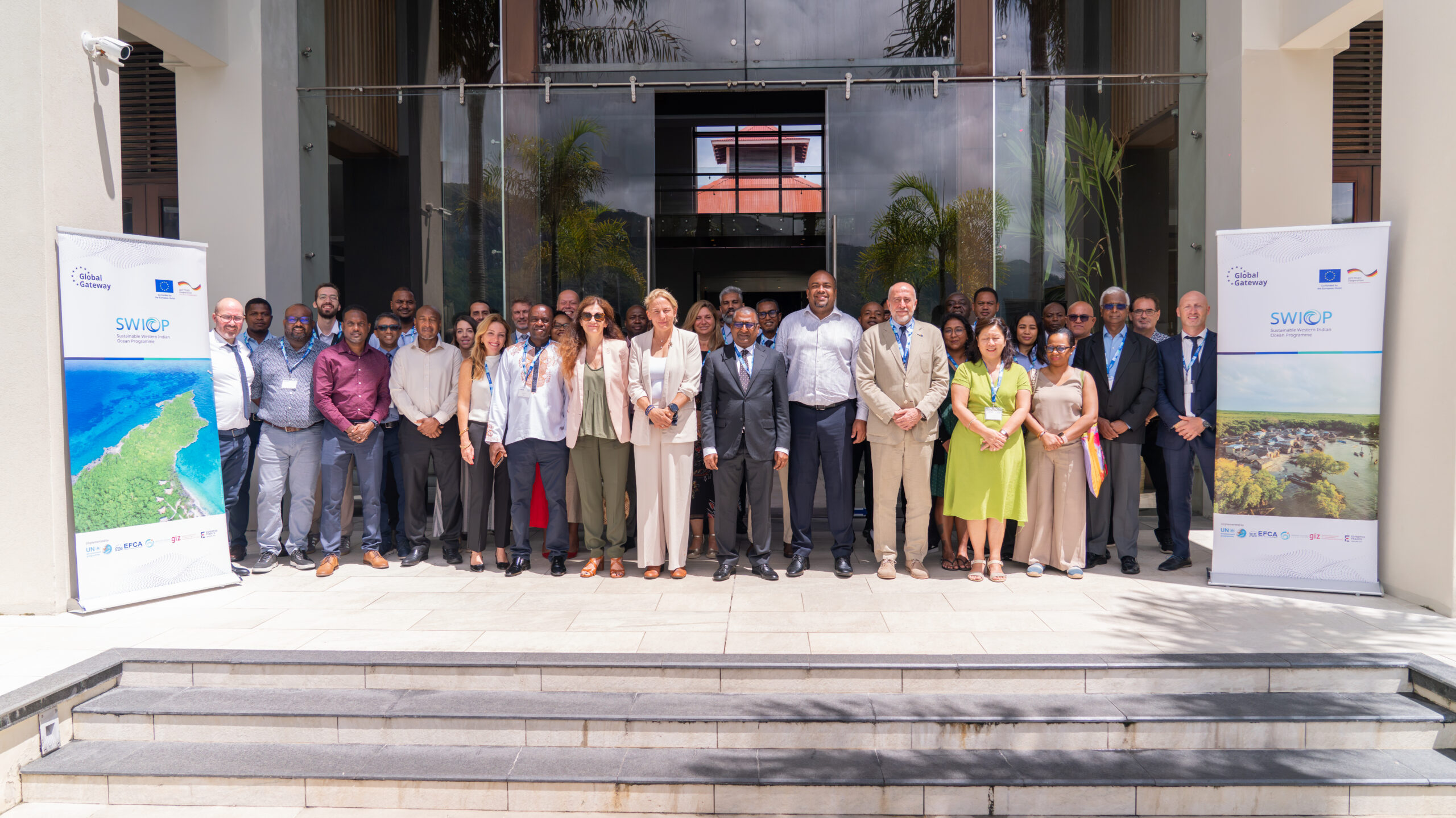
Jointly organised by the EU Delegation to Mauritius and Seychelles, EFCA, Expertise France and IOC, the launch brought together the Executive Director of EFCA, the Minister for Fisheries, Agriculture and the Blue Economy of the Republic of Seychelles, the French Ambassador in Seychelles and the Secretary General of IOC. The event marked a new chapter in regional cooperation in tackling IUU fishing, building on the experience and commitment of national authorities and regional partners.
SWIOP covers Comoros, Djibouti, Kenya, Madagascar, Mauritius, Mozambique, Seychelles, Somalia and Tanzania. Within its ocean governance pillar, the EFCA, Expertise France and IOC components contribute to the common objective of reducing IUU fishing, building on national priorities, existing regional cooperation and the experience of participating authorities.
EFCA supports beneficiary countries through a combination of operational cooperation and capacity development including support to joint fisheries monitoring and control activities through the IOC’s Plan Regional de Surveillance des Pêches (PRSP) patrols, as well as practical training to MCS personnel, support to stronger legislative and institutional frameworks, improved monitoring, control and surveillance systems and enhanced information exchange. Drawing on more than 20 years of experience in coordinating fisheries control in the European Union and other EU development programmes in Western Africa, the Agency works with beneficiary countries by responding to their needs in a collaborative and hands-on approach.
The IOC has established and coordinated the Regional Fisheries Monitoring Plan (RFMP) since 2007 with the support of the European Union. The RFMP constitutes a coordinated response to IUU fishing in the western Indian Ocean. Involving the five IOC Member States as well as Kenya, Mozambique, Somalia and Tanzania, the PRSP covers an area of over 6.5 million km² of EEZs. The PRSP enables joint patrols at sea, supplemented by aerial missions, facilitates the exchange of information and the pooling of resources, and strengthens fisheries surveillance and observation capabilities. It serves as a tool for prevention, intervention and deterrence. The PRSP is also taking a new step forward by establishing synergies with the Regional Maritime Security Architecture, which is also established and coordinated by the IOC, as well as with the planned creation of a Regional Centre for Fisheries Surveillance, Control, Monitoring and Observation.
Expertise France supports the conservation and management of high-seas and straddling fish stocks in the Western Indian Ocean. It provides dedicated support to two Regional Fisheries Management Organisations (RFMOs), the Indian Ocean Tuna Commission (IOTC) and the Southern Indian Ocean Fisheries Agreement (SIOFA), and to their Contracting Parties in the region. Building on the expertise of these RFMOs, the support aims to improve the data collection and production of scientific research on high-seas and straddling fish stocks, with the objective of ensuring the long-term sustainability of these resources for Coastal States in the Western Indian Ocean (WIO) region. Expertise France will also provide dedicated technical assistance to help Contracting Parties implement IOTC and SIOFA Conservation and Management Measures (CMMs).
“IUU fishing destroys ecosystems and IUU fishing does not stop at national borders. We can only tackle it by coordinated commitment and collaboration at regional level. SWIOP EU funded program provides that and by strengthening the regional MCS framework by way of joint patrol activities, targeted surveillance, information sharing and institutional and capacity building. EFCA stands ready to bring our experience and expertise to the SWIOP and are very excited and committed to the operational, “hands-on” model which the project will deliver with local partners.” Dr. Susan Steele, EFCA Executive Director.
“The fight against IUU fishing can only be effective if it is based on close, coordinated and sustainable cooperation between all the stakeholders concerned. Fishing activities and the movements of vessels transcend national borders. Responses must therefore be based on information-sharing, the coordination of operations, capacity-building and the pooling of expertise. This is precisely the purpose of the IOC’s PRSP, which the SWIOP programme will support. Through this programme, our aim is to consolidate existing regional mechanisms, improve Member States’ surveillance capabilities and strengthen operational cooperation between the institutions involved in combating IUU fishing.” – Dr Ibrahim Norbert Richard, Secretary-General of the IOC
“The launch of the fisheries component of the program under Pillar 1, with total support of EUR 11 million from the European Union marks an important milestone. It reflects a shared ambition: to promote the sustainable management of fisheries resources, strengthen the resilience of coastal and island states and consolidate maritime security in the Western Indian Ocean. The European Union places great importance on the preservation of the oceans and the sustainable use of marine resources. In a region where communities rely heavily on the sea for food, employment, and income, sustainable fishing is not merely an environmental issue; it is also an economic, social, and strategic one” – Mr Jose Maria Troncoso Perera, Head of Partnerships, Delegation of the European Union to the Republic of Mauritius and the Republic of the Seychelles.
“For Seychelles, the ocean is central to our food security, our economy and the livelihoods of our people. No country can tackle illegal, unreported and unregulated fishing alone. SWIOP gives us an opportunity to build on the progress achieved through the IOC’s Regional Fisheries Surveillance Plan, strengthen our fisheries monitoring and enforcement capabilities, and deliver lasting benefits to our fishing communities,” remarked Principal Minister Cosgrow, on that occasion.
Supporting sustainable fisheries and ocean governance
Background
Launched in June 2026 in Mombasa, Kenya, SWIOP is a five-year, EUR 60.5 million programme co-funded by the European Union (EUR 58 million) and the German Federal Ministry for Economic Cooperation and Development (BMZ) (EUR 2.5 million). Its three pillars focus on ocean governance, sustainable blue economy investment and marine ecosystem resilience.
The EFCA and IOC components contribute to Output 1.3 of Pillar 1, aimed at reducing IUU fishing. Expertise France implements the related Output 1.2 on conservation and management measures for shared fisheries resources through SIOFA and IOTC.
Source : EFCA