

John Ross Ward, the inventor of the life jacket
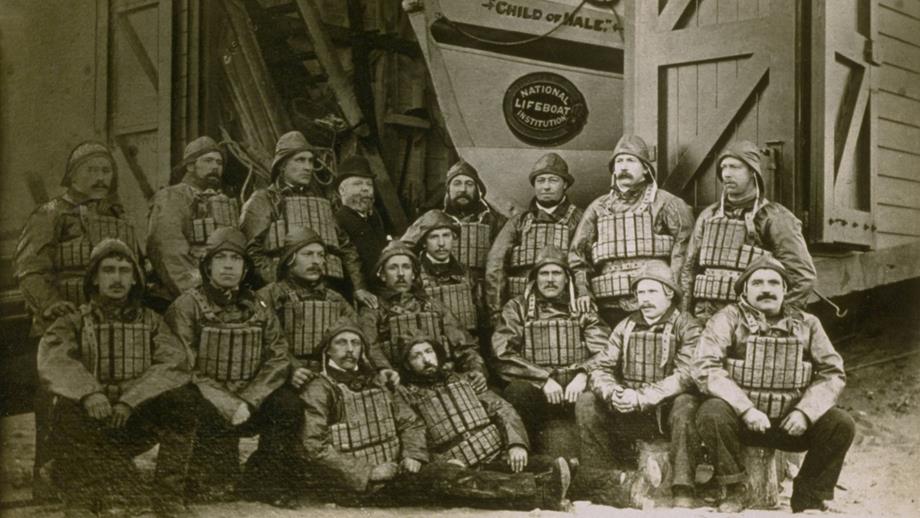
The life jacket, an essential element of maritime safety, was invented in the United Kingdom in 1854 by the British captain John Ross Ward. Today, we recount the remarkable journey of this man whose legacy continues to save lives.
An early naval vocation
John Ross Ward was born on 3 August 1813. He was the second son of Vice-Admiral William Ward, a British officer who saw many active engagements at a time when the British Empire exercised its dominance over the seas even more intensely.
Destined early for a naval career, he entered the Royal Naval College on 3 November 1826 and passed the lieutenant’s examination in 1833, earning a silver medal—the first prize in mathematics—which granted him two years of seniority.
On 10 January 1835, he received his first commission as a lieutenant.

His successive postings were as follows:
- on 6 April 1835, aboard the Tweed (20 guns), under the command of Captain F. T. Pelham, on the Lisbon station;
- on 6 May 1839 and 27 October 1840, respectively aboard the Impregnable (104 guns) and the Caledonia (120 guns), serving as flag lieutenant to Sir Graham Moore, Commander-in-Chief at Plymouth.
On 18 October 1842, he was appointed first lieutenant of the Belvidera (38 guns), commanded by the Honourable George Gray, in the Mediterranean. Shortly after the ship was paid off, he was promoted, on 24 March 1845, to the rank of Commander.
From coastal service to sea rescue
On 28 September 1846, he was appointed to the Coastguard and carried out coastal duties for the following four years.
In 1851, at the request of Algernon Percy, 4th Duke of Northumberland, John Ross Ward conducted experiments on lifeboats along the coast of Northumberland. This mission marked a decisive turning point in his career.
On 5 February 1852, he was elected a member of the Committee of the Royal National Lifeboat Institution (RNLI), before being appointed, in August 1852, Inspector of Lifeboats. In November of the same year, he received the RNLI silver medal in recognition of the serious risks he had taken during experimental trials of new lifeboats in heavy weather on the north-east coast.
Around the same time, he was awarded the silver medal of the Royal Humane Society for saving, at the risk of his own life, a woman who was attempting to take her own life on a dark night at Stockton-on-Tees.
The invention of the life jacket
In 1854, John Ross Ward invented the first cork life jacket, which took the form of a belt made of pieces of cork sewn inside it. In November of the same year, it was distributed to the crews of RNLI lifeboats.
This life jacket marked a major advance in maritime safety. The RNLI subsequently developed, based on his design and at his suggestion, a modified version intended for seafarers.
The Titanic was equipped with cork life jackets—but in insufficient numbers.
Recognition
On 5 February 1858, John Ross Ward was promoted to the rank of Captain. In February 1864, the Committee of the Royal National Lifeboat Institution presented him with a model lifeboat accompanied by its transport carriage, as a modest recognition of his eminent services, particularly his contribution to the improvement of the self-righting lifeboat, as well as his inventions of the life belt and the transport carriage.
In 1865, on his recommendation, the Committee had several safety fishing boats built according to his plans. These boats were placed as models along various parts of the coastline to encourage fishermen to adopt this type of vessel and thereby reduce the annual loss of life caused by the use of undecked boats. The results were highly satisfactory.
In the same year, Empress Eugénie awarded him the gold medal of the French Lifesaving Society in recognition of his significant services. For similar merits, he later received a sumptuous silver and crystal distinction from Empress Feodorovna of Russia, then Tsarina.
A discreet but exemplary end to his career
On 11 December 1875, he attained the rank of Rear Admiral, then that of Vice-Admiral on 20 January 1880, becoming a full Admiral on 1 July 1885.
In 1883, at the age of 70, he retired from his post as Chief Inspector of Lifeboats after more than thirty years of service. The RNLI Committee then awarded him the Institution’s gold medal, along with official thanks recorded on vellum.
From that date until his death on 23 June 1890, at the age of 77, following a very brief illness, John Ross Ward remained faithful to the meetings of the RNLI committee and deeply committed to the affairs of the Institution. He was buried on 28 June 1890 in Kensington Cemetery, Hanwell.
References: