
Cameroonian Maurice Kengne Kamga Elected President of the International Tribunal for the Law of the Sea (ITLOS) for the 2026–2029 Term
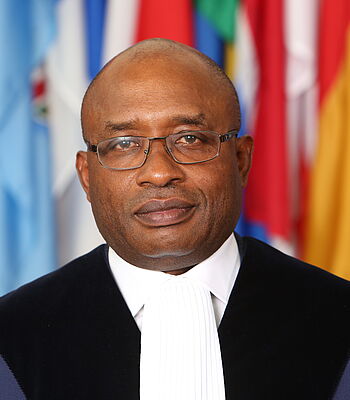 Cameroonian diplomat and academic Maurice Kengne Kamga was elected President of the International Tribunal for the Law of the Sea (ITLOS) on 1 October 2026 for the 2026–2029 term. At 59, he becomes the first French-speaking president and the youngest president in the history of this international judicial body.
The International Tribunal for the Law of the Sea (ITLOS) has a new president. On 1 October 2026, its members elected Cameroonian Maurice Kengne Kamga to lead the institution for the 2026–2029 term. The election took place during the Tribunal’s sixty-second administrative session.
A member of ITLOS since 1 October 2020, Maurice Kengne Kamga assumes the presidency of this international judicial body following a distinguished professional and academic career marked by extensive expertise in international law, particularly the international law of the sea.
Born on 12 May 1967 in Bandjoun, Cameroon, he is a diplomat, legal expert and academic. He becomes the second Cameroonian national to serve on the International Tribunal for the Law of the Sea, following Paul Bamela Engo.

An Outstanding Academic Background in International Law
The new ITLOS President has an extensive academic background, having pursued his studies in Cameroon, Switzerland and France.
After obtaining a bachelor’s degree, a master’s degree and a postgraduate master’s degree in public law from the University of Yaoundé in 1989, 1990 and 1991, respectively, he pursued further studies in international relations at the International Relations Institute of Cameroon. There, he obtained a master’s degree in 1991 and a doctorate in 1994, specialising in diplomacy.
His academic journey subsequently took him to the Graduate Institute of International Studies in Geneva, Switzerland. In 1997, he obtained a postgraduate diploma in international relations, specialising in international law, followed by a doctorate in international law in 2003. His doctoral thesis, devoted to the international law of the sea, received the highest distinction, the jury’s congratulations and authorisation for publication.
He further strengthened his academic credentials through several sessions at The Hague Academy of International Law in 1996, 2003 and 2005. In 2017, he obtained the accreditation to supervise research in public law from Paris Nanterre University.
A Career at the Intersection of Diplomacy and International Courts
Maurice Kengne Kamga has built a career combining diplomatic responsibilities, international legal expertise and higher education.
He began his professional career as a teaching assistant in public international law and constitutional law at the University of Yaoundé between 1993 and 1995. At the same time, he joined Cameroon’s Ministry of External Relations in 1994, where he held various positions, including responsibilities in African affairs and as a legal adviser. He has held the rank of Minister Plenipotentiary since 2010 and has participated in numerous Cameroonian delegations involved in bilateral and multilateral negotiations.
His international experience subsequently expanded through several positions within judicial institutions and international organisations. Between 1997 and 2001, he worked as an assistant lawyer-linguist at the International Criminal Tribunal for the former Yugoslavia in The Hague, the Netherlands. He then joined the International Tribunal for the Law of the Sea in Hamburg, Germany, as a legal officer responsible for publications from 2001 to 2002.
He also served as a consultant to the Legal Office of the Food and Agriculture Organization of the United Nations (FAO) between 2001 and 2007. His assignments included work on the drafting of national legislation relating to fisheries and aquaculture.
From 2008 to 2020, he served as a legal officer at the International Court of Justice in The Hague. This experience at one of the world’s principal international judicial institutions represented a major milestone in his professional career.
A Longstanding Commitment to Teaching and Research
Alongside his diplomatic and legal responsibilities, Maurice Kengne Kamga has maintained an active academic career.
He has been an associate professor at the International Relations Institute of Cameroon since 2006 and at the Catholic University of Lille since 2011. He has also taught and delivered lectures at numerous universities and institutions across Africa, Europe and beyond.
His teaching and conference activities have taken him to the Brussels School of International Studies, the World Maritime University in Malmö, the International Maritime Law Institute in Malta, the United Nations University and several academic institutions in Cameroon, Belgium, the Netherlands and Türkiye.
He has also contributed to training new generations of researchers by supervising or co-supervising numerous doctoral theses and serving on university examination committees in Africa and Europe since 2011.
Since 2021, he has also been the founder and Executive President of HITAS (Hanseatic Institute of Technology and Applied Sciences), a private higher education institution based in Douala, Cameroon.
His commitment to international law is further reflected in his involvement in professional associations. He served as Secretary-General of the Association of Participants and Alumni of The Hague Academy of International Law from 2011 to 2017. He has been a founding member of the African Society of International Law since 2012 and a member of the French Society for International Law since 2015.
A Historic Presidency for ITLOS
Maurice Kengne Kamga’s election as President of the International Tribunal for the Law of the Sea marks an important milestone in the Cameroonian diplomat’s career. At 59, he becomes the first French-speaking president and the youngest president in the history of the institution.
His career, characterised by extensive expertise in the international law of the sea, experience within several international judicial institutions and a sustained commitment to higher education, provides the foundation for his new responsibilities at the helm of the Tribunal for the 2026–2029 term.
His election places a Cameroonian specialist in international law at the head of an international judicial institution dedicated to the law of the sea, following six years of service within the Tribunal.