Classification Societies in the Maritime Industry
Classification societies are private organizations that play a crucial role in the maritime industry. They were originally created in response to a need expressed by marine insurers: to have reliable criteria for determining ship insurance premiums.
Thus, in the first half of the 19th century, the first classification societies—private entities—were established by marine insurers to assign a reliability rating to ships. Over time, these societies evolved to directly draft the standards they would apply: the class rules.
Classification societies establish, apply, and maintain strict technical standards throughout all stages of a ship’s life: from design to commissioning, including construction, repairs, and operation.

They are also responsible for certifying that ships and their main equipment meet the requirements of technical reference frameworks such as classification rules, or other statutory standards like the International Convention for the Safety of Life at Sea (SOLAS) or the Load Lines Convention (LL).
The very first classification society was founded in 1760 at Edward Lloyd’s Coffee House in London by merchants and insurers, who recorded ships in a register and assigned them a reliability rating. This society, formerly called “The Society for the Registry of Shipping,” is known today as Lloyd’s Register.
Classification societies provide several services, including:
- Classification, which involves classifying ships according to specific criteria (based on the society’s own rules), after which the society assigns a class;
- Certification, which involves verifying the compliance of ships and their equipment with national and international regulations; and
- Publication of registers, which list the classified ships.
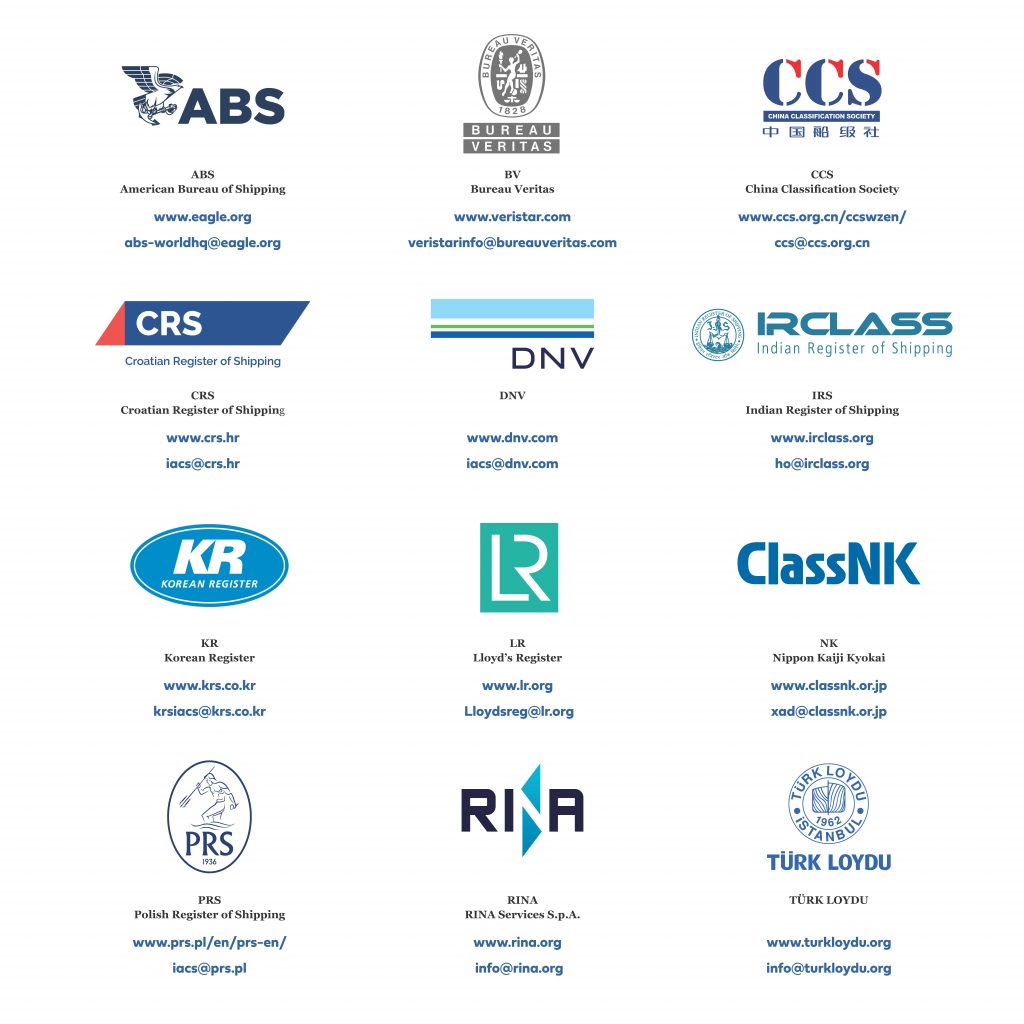
The main classification societies are grouped within the IACS (International Association of Classification Societies), which currently has twelve member marine classification societies. The rules and standards issued by these twelve IACS member societies cover more than 90% of the world’s cargo-carrying tonnage.