
Malcolm McLean – the inventor of the container
Dear Maritimafrica subscribers!
The shipping container, the main tool for cargo transportation, is an indispensable element in maritime transport. Today, we tell you the story of the man who invented it and revolutionized the maritime field in every way.
 Malcolm McLean was born in Maxton, North Carolina on November 14, 1913. The son of a farmer from a middle-class family, he became the manager of a gas station in 1931 and completed his studies at Winston Salem High School in 1935. In 1934, one of his customers asked him to deliver fuel drums by truck about a hundred kilometers away. To avoid using a local carrier, Malcolm McLean decided to transport the goods himself. With his savings, he bought an old truck and created McLean Trucking Company, while maintaining management of the gas station. A year later, he owned three trucks. From then on, his company’s growth was meteoric, benefiting from American growth following the 1929 crisis and World War II: in 1940, he owned 30 vehicles, then 620 in 1950, and nearly 2,000 in 1953.
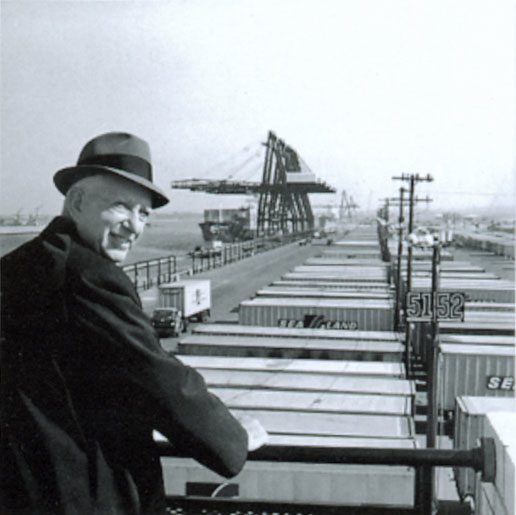 Seeking to minimize costs as much as possible, he was the first carrier to have Diesel engines installed on all his vehicles. At a time when the Interstate Commerce Commission was seeking to regulate competition and protect railway companies by limiting the number of lines each trucking company could operate, McLean Trucking Company’s financial discipline allowed it to methodically buy out its competitors’ operating rights and thus be present across much of American territory.

In 1953, barely twenty years after its creation, McLean Trucking Company was already the second-largest trucking group in the United States. That same year, as highways connecting different West Coast ports were hit by increasingly significant traffic jams, McLean imagined a way to directly load his truck trailers onto boats so that they could handle port-to-port traffic without having to unload and reload vehicles each time. For this purpose, terminals could be built on the waterfront where trailer transfer operations would be carried out. Malcolm McLean had actually revived a practice that already existed in rail transport at the beginning of the 20th century in France, England, and the United States but was abandoned due to insufficient traffic on each proposed destination.
In 1955, Malcolm McLean decided to sell McLean Trucking Company given the terms of the Interstate Commerce Commission prohibiting him from combining two different transport activities. With the money earned ($25 million), he bought a small shipping company, Pan-Atlantic Steamship Company, which he later renamed Sea-Land Service.

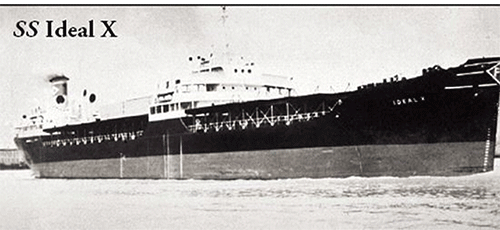
In January 1956, he took out a loan of $22 million, which allowed him to buy two World War II-era tankers. He then conducted his first transfer experiments in the port of Newark (New Jersey) but found that his original idea didn’t solve all the problems of wasted space. Even if the truck remained on the dock, the trailers were loaded with their chassis, making it difficult to rationally use space aboard the ship. He quickly solved the problem by removing the chassis to load only the upper part of the trailer. He presented his discovery to his guests aboard the “Ideal-X” on April 26, 1956.
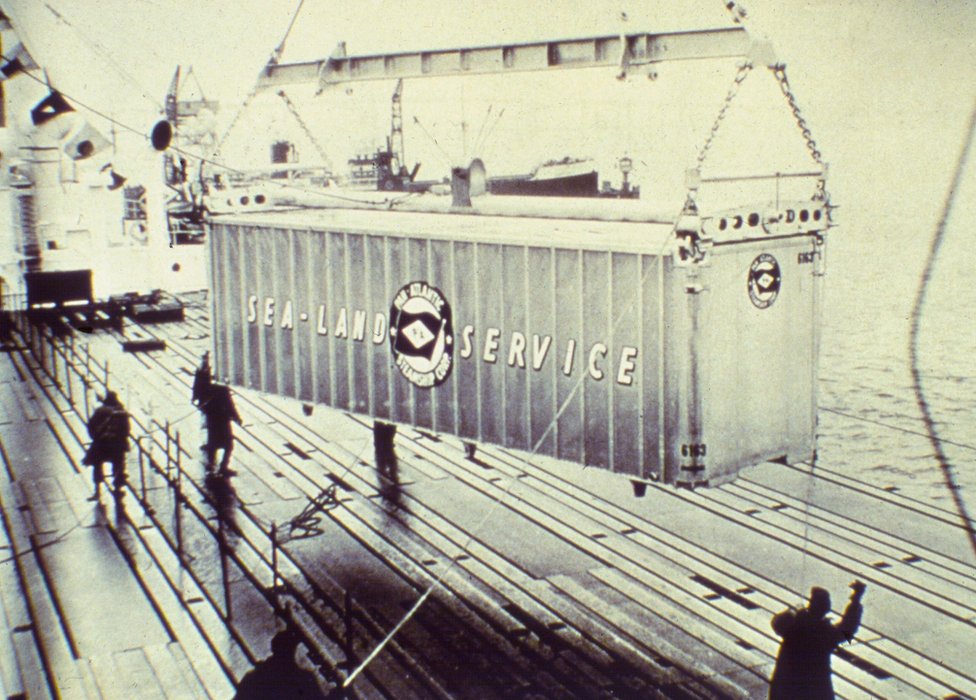
The container was born and allowed handling costs to be reduced by nearly 70%. Companies could thus leave the ports, where land prices were prohibitive, and settle far inland, closer to major consumer basins where containers were then directly delivered to them by train or truck.
In 1967, during the Vietnam War, the Department of Defense entrusted Sea-Land Service with shipping military equipment to Southeast Asia. But due to its impact on world trade, the container quickly escaped its designer’s control.
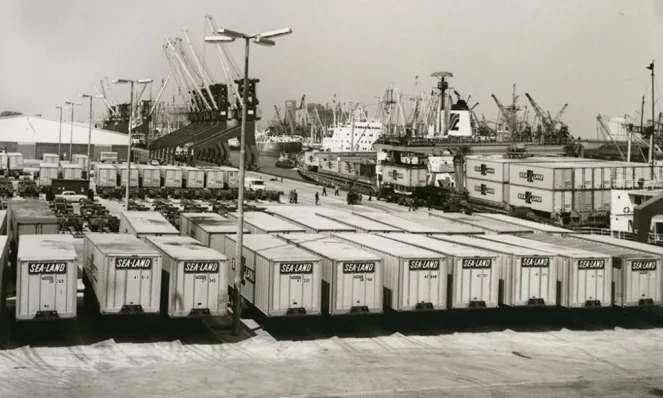
In 1969, faced with competition from new operators, Malcolm McLean sold his company to the American Reynolds Tobacco Company. He remained a board member but resigned in 1977 to re-enter maritime transport by buying United States Lines, which went bankrupt in 1987. He then founded a third company, Trailer Bridge Inc, which operated between the United States and Puerto Rico. In 1999, Sea-Land Service was bought by Maersk Lines.
On May 25, 2001, he died in New York from heart failure. Upon the announcement of his death at age 87, all container ships at sea lowered their flags to pay tribute to him. He is considered a true pioneer of globalization.
References :
https://www.nytimes.com/2001/05/29/nyregion/m-p-mclean-87-container-shipping-pioneer.html
https://www.lesechos.fr/2007/07/malcom-mclean-552779
https://fr.wikipedia.org/wiki/Malcom_McLean
https://businessadventurers.com/malcom-mclean-et-la-revolution-du-container/
https://www.lantenne.com/La-conteneurisation-de-l-Europe-maritime-a-50-ans_a31405.html