Maritime Governance in the Gulf of Guinea: Differentiated Cross-Cutting Implementation of Various Rights of Pursuit

Introduction
The geographic and political Gulf of Guinea is a region where issues, constraints, and challenges related to maritime governance are fully illustrated— legally, economically, and even geopolitically. Concerns about maritime security are also deeply present and pressing. The sea in this part of the world is simultaneously a space of cooperation and conflict, of encounters as well as various rivalries and divisions. It is a zone that is both very rich and yet where wealth has been slow to generate prosperous states.
In short, the Gulf of Guinea faces major challenges in terms of maritime security, including piracy, terrorism, human trafficking, illegal immigration, various cross-border smuggling activities, IUU (Illegal, Unreported and Unregulated) fishing, pollution of different kinds, drug trafficking and psychotropic substances, oil siphoning, arms trafficking—and the list is far from exhaustive. These various threats compromise, to varying degrees, not only the security of maritime routes but also the socio-economic development of the coastal countries. As a result, some consider this region to be the most dangerous and insecure in the world for the maritime industry.

In this strategic space for international navigation, multiple initiatives have been implemented over the past two decades to strengthen maritime security. Regional frameworks such as the Gulf of Guinea Commission (GGC) and various international agreements have emerged, aiming to coordinate the efforts of coastal states and mobilize the support of the international community. Despite these efforts, challenges remain, highlighting the need for a thorough reassessment of the current mechanisms dedicated to contemporary maritime security and safety issues.
The operationalization of the Yaoundé Architecture has thus been a complex, ongoing process— marked by significant progress but also by persistent challenges, and strongly influenced by historical, geopolitical, and socio-economic factors. Indeed, the resurgence of maritime threats in the 1990s triggered a political awakening, which from 2009 onwards, vigorously opened up multiple possibilities for the political pooling of anti-insecurity efforts.
This had a direct impact on the military operations of navies and/ or coast guards of Gulf of Guinea states, who are the true field actors implementing the various laws and regulations aimed at combating maritime insecurity. The United Nations Security Council would later drive the point home with two major and relevant resolutions — 2018 (October 31, 2011) and 2039 (February 29, 2012) — which were much later complemented by Resolution 2634 (May 31, 2022), aligned with the same unified and mutualist approach as the previous ones. Very quickly, however, the issue of operational pursuit rights and their management became central to the debates and challenges, sometimes acting as an obstructive barrier, other times as an effective offensive option against the transnationalisation of crime and the absence of physical boundaries at sea — a space where criminality and criminals seemed to operate with relative ease and brazen confidence.
In order to reach an acceptable minimum service level — balancing sovereignty protection with openness on issues involving transnational stakes that often clashed with sovereign and even sovereignist egos and antagonisms — the States Parties to the Gulf of Guinea Maritime Security and Safety Architecture have gradually and courageously gone beyond the limits set by the 1982 UNCLOS as well as the Yaoundé Code of Conduct i and its counterpart, the Djibouti Code of Conduct ii. They patiently developed, in parallel, pioneering and original mechanisms such as the Yaoundé Technical Agreement iii and the Kinshasa Memorandum of Understanding iv. A nod also goes to the so-called PROSPERITY Agreement v, a unique legal framework launched between Nigeria and Benin at the height of the maritime security crisis off their coasts.
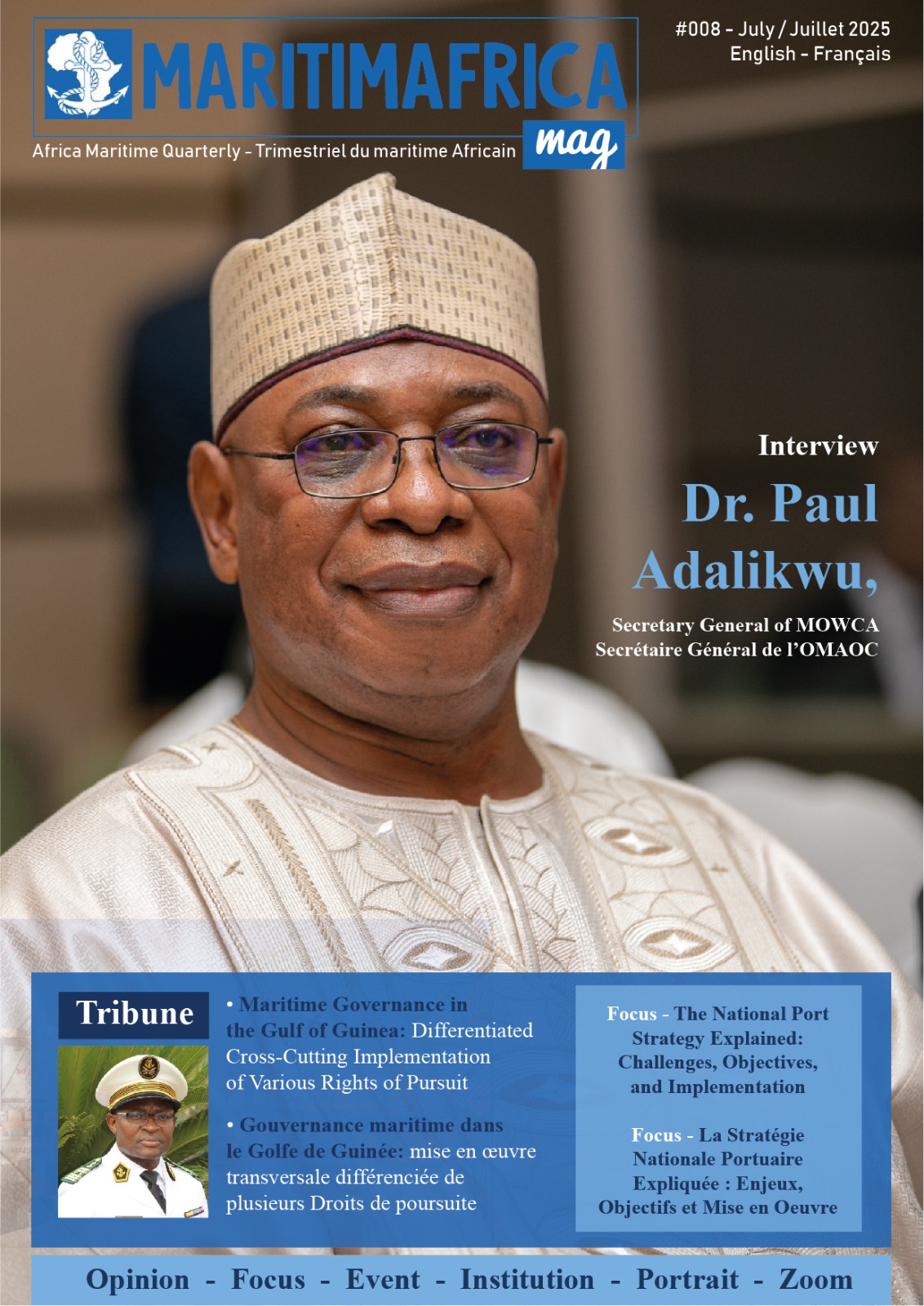 Read the rest of the article on page 24 of the 8th issue of Maritimafrica Mag : https://maritimafrica.com/en/wp-content/uploads/2025/07/Maritimafrica-Mag-juillet-2025-Eng-Fr.pdf