Robert Fulton: The Inventor Who Transformed Steam Navigation
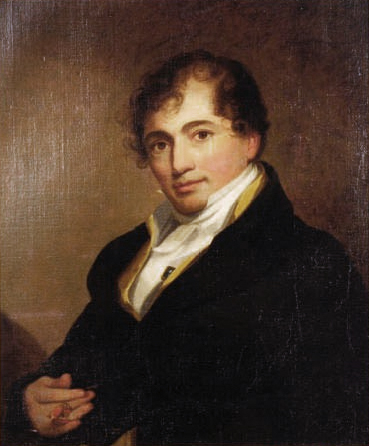
Often described as the inventor of the steamboat, Robert Fulton was above all the man who succeeded in turning an old idea into a functional and commercially viable innovation. Through his work on steam propulsion, submarines and naval technologies, this American inventor profoundly shaped the history of navigation and inland waterway transport.
Early Life Between Painting and Invention
Robert Fulton was born on November 14, 1765, in Little Britain, Pennsylvania, United States. He was the son of Robert Fulton Sr. and Mary Smith, who had five children together: Isabella, Elizabeth, Mary, Abraham and Robert.
For six years, he lived in Philadelphia, where he pursued several artistic activities. He painted portraits and landscapes, designed houses and machinery, while also providing financial support to his mother. His father died in 1774, when Robert Fulton was still a child.
In 1786, suffering from health problems, he travelled to Europe in the hope of recovering his health. He settled in England, where he was welcomed by painter Benjamin West. He continued his artistic activities while developing an increasing interest in mechanical experiments and technological innovations.

His First Research into Canals and Steamboats
From 1793 onwards, Robert Fulton began working on projects to improve inland waterways. In particular, he envisioned canals using inclined planes instead of locks. He obtained a patent for this concept in 1794. He was also interested in using steam power to propel boats.
During this period, he published a pamphlet on canals and patented a dredging machine, along with several other inventions. In 1793, he also submitted plans for steam-powered vessels to the American and British governments.
However, it is important to remember that Fulton was not the first person to conceive or build a steamboat. Several inventors had already conducted experiments in this field.
In France, Claude de Jouffroy had built the Palmipède, a boat whose engine operated a set of paddles. It was tested on the Doubs River in 1776. In 1783, de Jouffroy built the Pyroscaphe, considered the first paddle-wheel boat, which successfully navigated the Saône River.
In the United States, John Fitch also conducted a successful steamboat trial on the Delaware River on August 22, 1787. William Symington, meanwhile, had successfully tested steam-powered boats in 1788. Fulton was probably aware of these various developments.
An Experiment in England with Canals
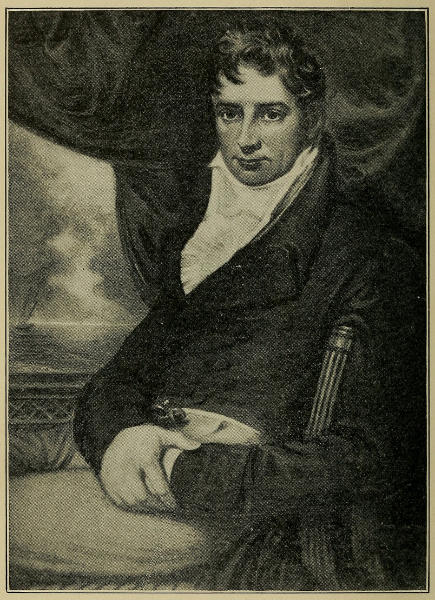
In 1794, Fulton moved to Manchester to acquire practical knowledge of inland waterway engineering. There, he met Robert Owen, a cotton manufacturer and future pioneer of socialism.
Impressed by his projects, Owen agreed to finance the development and promotion of his inclined planes and excavation machinery. He also played an important role in introducing Fulton to a canal company, which awarded him a subcontract.
However, the experiment did not produce the expected results. Fulton failed to implement his project successfully and abandoned the contract shortly afterwards.
In Great Britain, he also met Francis Egerton, Duke of Bridgewater, whose canal became a testing ground for a steam-powered tugboat. Fulton gradually became a strong advocate of canal development. In 1796, he wrote a treatise on canal construction, proposing several improvements, particularly concerning locks and other structures.
Between 1796 and 1799, he worked for the Duke of Bridgewater. A boat was built at the Duke’s wooden shipyard under the supervision of Benjamin Powell. After machinery supplied by engineers Bateman and Sherratt of Salford had been installed, the boat was named Bonaparte, in reference to the services Fulton had rendered under Napoleon.
Despite several costly trials, the experiment was eventually abandoned. Those in charge were particularly concerned that the configuration of the paddle wheels might damage the canal’s clay lining. Meanwhile, William Symington’s work led to the development of the Charlotte Dundas, a steam-powered tugboat tested in 1803. This project represented another important milestone in the history of steam propulsion on inland waterways.
The Nautilus: A Major Breakthrough in the History of Submarines
In 1797, Robert Fulton travelled to Paris, where he was already recognised as an inventor. He studied French, German, mathematics and chemistry.
He was also interested in the panorama, a form of artistic entertainment consisting of a large circular painting that gave spectators the impression of being immersed in a landscape or historical scene. Fulton helped introduce and develop this type of entertainment in Paris by having a venue specially designed for this purpose. Painter Pierre Prévost presented several panoramas there, including View of Paris from the Tuileries, created around 1800. The Passage des Panoramas, which still exists today, recalls the history of this activity in the French capital.
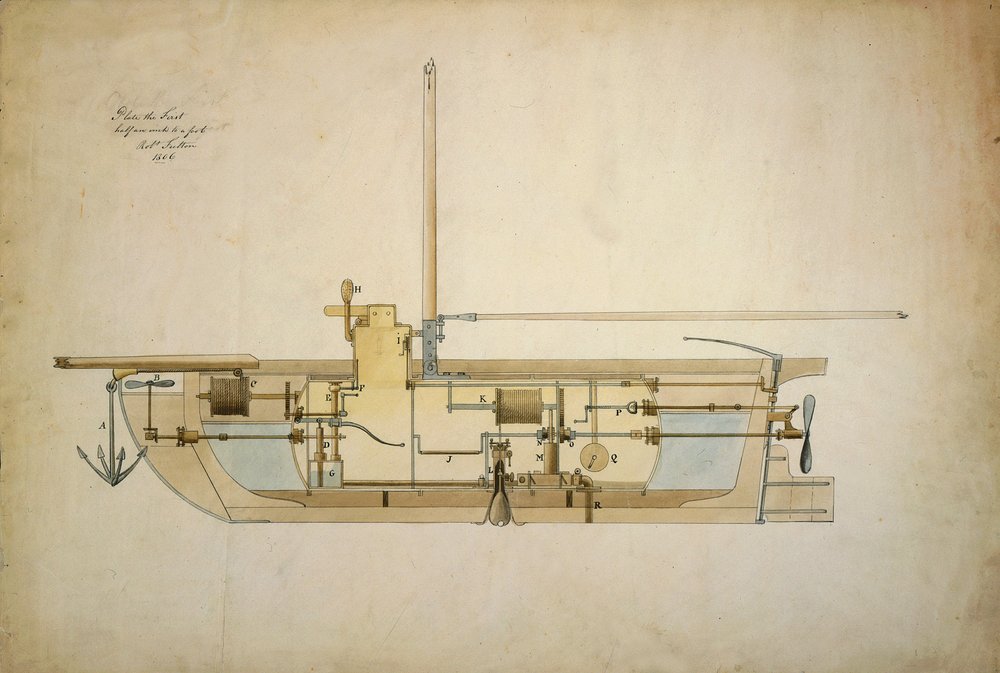
Alongside his artistic activities and research into steam navigation, Fulton developed a particularly ambitious project: the Nautilus, an experimental submarine designed to demonstrate the possibility of travelling beneath the surface of the water. Developed in the late 1790s and tested in 1800, this vessel represented an important milestone in the evolution of underwater technology.
According to Fulton’s descriptions, as reported in Alice Crary Sutcliffe’s book, the Nautilus was approximately 20 feet long (6.1 metres) and 5 feet in diameter (about 1.5 metres). According to calculations by French scientist Louis-Bernard Guyton de Morveau, its internal volume provided enough air for three people and a candle for three hours.
The submarine was equipped with various mechanisms that enabled it to travel both on the surface and underwater. On the surface, it could use sails and oars. Underwater manoeuvring relied on a system of adjustable wings, some of which were positioned horizontally at the front of the vessel to control its depth.
In August 1800, Fulton conducted a series of experiments in Le Havre, France, to demonstrate the capabilities of his invention. On August 24, he submerged the vessel in the harbour basin to a depth of 15 feet (approximately 4.6 metres), accompanied by two people and carrying a lit candle. The three occupants remained underwater for one hour without experiencing any difficulty.
The following day, August 25, he tested a propulsion system consisting of four-foot-diameter wings, similar to the sails of a windmill. He compared the performance of this mechanism with that of oars. Two men took seven minutes to cover approximately 192 yards (176 metres) using oars. With the sails, they covered the same distance in four minutes. Fulton concluded that the speed achieved with this system was approximately twice that of rowing.
On August 26, he continued his experiments by working on the submarine’s stability and depth control. Using two horizontal wings installed at the front and operated from inside the vessel, he attempted to make the Nautilus descend or rise. However, this first depth-control test did not produce the expected results.
On August 27, he finally succeeded in keeping the Nautilus approximately five feet (1.5 metres) below the surface while travelling a distance of 90 toises, or about 176 metres. He also discovered that the compass worked just as well underwater as it did on the surface.
These experiments enabled Fulton to demonstrate that his submarine could submerge, return to the surface, travel underwater and be steered with precision.
On August 27, 1800, he also conducted a particularly significant experiment in the field of underwater weapons. From an ordinary boat, he directed a torpedo containing approximately 30 pounds of gunpowder (nearly 13.6 kilograms) towards a barrel anchored in the harbour. Using a control cable, he managed to position the explosive charge beneath the barrel and detonate it. The explosion completely destroyed the target and sent a large column of water into the air. This experiment illustrated the military potential of the underwater explosive devices he was seeking to develop.
On September 12, 1800, Fulton left Le Havre for La Hougue aboard the Nautilus. During this voyage, the submarine sometimes reached a speed of approximately one and a half leagues per hour, equivalent to nearly 4.5 miles per hour (about 7.2 km/h). This demonstrated that his vessel could also navigate on the surface like an ordinary boat.
Fulton subsequently continued his experiments in the Normandy region, particularly near the Marcouf Islands, where he sought to demonstrate the military capabilities of his submarine against British ships. However, attempts to approach these vessels did not produce the expected results. Details concerning a continuous six-hour submersion are not sufficiently corroborated by the historical sources consulted and have therefore not been included in this chronology.
Through these experiments, Fulton believed he had demonstrated the feasibility of underwater navigation. In a report dated November 7, 1801, he presented the results of his work and stated that the main technical challenges associated with his invention had been overcome.
He then proposed placing his invention at the service of the French Navy and training crews capable of operating this new form of naval warfare. Following several approaches to the French authorities and a meeting with Napoleon Bonaparte, his proposal eventually received a favourable response. A sum of 10,000 francs was made available to him to repair the Nautilus, build additional equipment and transport the vessel to Brest.
In Brest, Fulton continued his experiments and organised a demonstration for several officials. He succeeded in blowing up a large sloop using an underwater device, further illustrating the military potential of his invention. However, despite his efforts, British ships proved difficult to approach, and the prospects for the operational deployment of the Nautilus remained limited.
The project therefore did not lead to its lasting adoption by the French Navy. Nevertheless, it represented an important contribution to the history of submarines and underwater naval weapons. Fulton’s work demonstrated that it was possible to control submersion, travel underwater for several hours and use explosive charges against enemy ships.
An Early Attempt at a Steamboat on the Seine
During his stay in France, Fulton met Robert R. Livingston, who had been appointed United States Ambassador to France in 1801. The two men shared an interest in science and technological innovations.
They decided to collaborate on the construction of a steamboat intended to navigate the Seine River. Fulton conducted several experiments to study water resistance on different hull shapes. He prepared plans, built models and eventually had a boat constructed.
During the first trial, the system worked perfectly. However, the hull subsequently had to be rebuilt and reinforced.
On August 9, 1803, while the boat was travelling upstream on the Seine, it sank. It was approximately 20 metres long and 2.4 metres wide, and could reach a speed of 3 to 4 miles per hour (approximately 4.8 to 6.4 km/h) against the current.
Although the experiment ended in failure, it enabled Fulton to continue his research and improve his knowledge of steam navigation.
Military Inventions in the Service of Great Britain
In 1804, Robert Fulton returned to Great Britain. Prime Minister William Pitt the Younger then entrusted him with an important mission: designing various weapons for the Royal Navy, against the backdrop of the threat of Napoleonic invasion.
Among his inventions were the first modern naval torpedoes, underwater explosive devices whose operating principles were closer to those of naval mines than to those of modern self-propelled torpedoes.
These weapons, along with several other inventions by Fulton, were tested during the raid on Boulogne in 1804. However, the results were limited.
Fulton continued working with the British until 1806. However, the decisive victory of the British Navy, commanded by Admiral Horatio Nelson, at the Battle of Trafalgar in 1805 considerably reduced the threat of a French invasion. His military inventions gradually became less relevant to the British authorities.
The Clermont: The Steamboat That Changed the History of Transportation

In 1806, Robert Fulton returned to the United States. He resumed his collaboration with Robert R. Livingston and focused on developing a steamboat capable of providing regular commercial services.
In 1807, the two men built the North River Steamboat, which later became better known as the Clermont. This vessel became the first commercially viable steamboat in the United States.
Livingston’s shipping company began using it to transport passengers between New York City and Albany, the capital of New York State, travelling upstream along the Hudson River. The Clermont covered a distance of 150 miles (approximately 241 kilometres) in 32 hours. This maiden voyage demonstrated that a steam-powered vessel could provide regular passenger transportation over long distances.
The Clermont was the first steamboat to achieve commercial success in America. During its construction, the vessel was nicknamed “Fulton’s Folly” by people who doubted its ability to operate. However, it eventually proved them wrong.
In its original configuration, the Clermont measured approximately 133 feet long (40.5 metres) and 18 feet wide (5.5 metres). It was subsequently modified and rebuilt during the winter of 1807–1808. In its modified configuration, it measured approximately 130 feet long (39.6 metres) and 16.5 feet wide (about 5 metres).
The Clermont was equipped with sails in addition to its steam engine. At each end of the boat was a short mast fitted with a small square sail, which could be deployed when necessary. Its engine, rated at approximately 18 horsepower in some historical descriptions of its modified configuration, was installed in the centre of the vessel and surrounded by stacked firewood. A tall, narrow smokestack rose above the engine. On each side of the boat was a large, open and uncovered paddle wheel measuring approximately 15 feet (4.6 metres) in diameter. The vessel had a stated displacement of 160 tons.
For this invention, Fulton obtained two patents, one in 1809 and another in 1811.
This achievement marked a turning point in the history of inland waterway and maritime transportation. It demonstrated that steam power could be used reliably to transport people and goods, opening up new commercial opportunities.
The New Orleans: The Steamboat That Travelled Down the Ohio and Mississippi Rivers to New Orleans
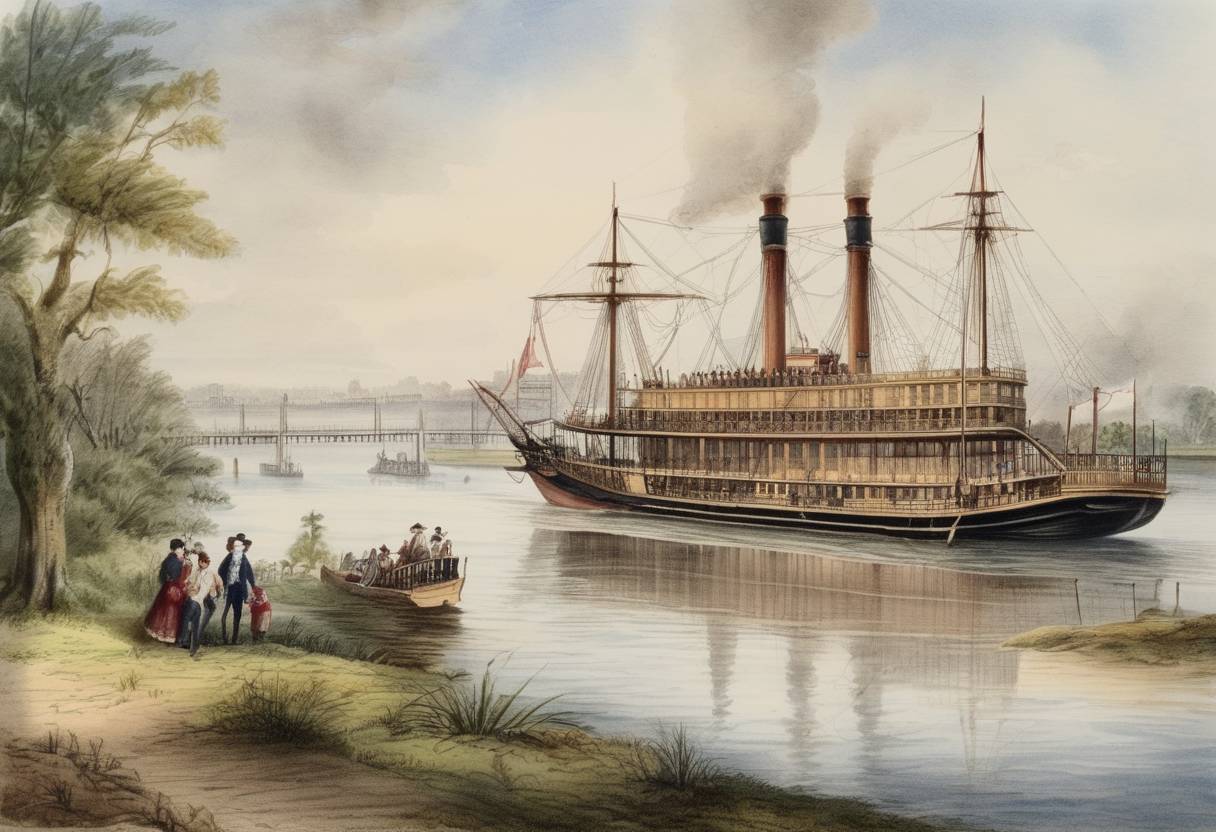
In 1811, Robert Fulton, Robert R. Livingston and Nicholas Roosevelt brought a new project to life: the New Orleans, a steamboat designed to navigate the Ohio and Mississippi Rivers all the way to New Orleans, Louisiana. Construction of the vessel was supervised by Nicholas Roosevelt in Pittsburgh, Pennsylvania.
The boat left Pittsburgh on October 20, 1811. It then stopped at Wheeling, West Virginia, followed by Cincinnati, Ohio. It passed through the famous Falls of the Ohio at Louisville, Kentucky, before reaching Cairo, Illinois, at the confluence of the Ohio and Mississippi Rivers. The boat then continued towards Memphis, Tennessee, followed by Natchez, Mississippi, before finally reaching New Orleans, located approximately 140 kilometres from the coast of the Gulf of Mexico.
The New Orleans arrived in Louisville on October 28, 1811, and continued its journey down the Mississippi. It reached Natchez on December 30, 1811, before finally arriving in New Orleans on January 10, 1812, after a journey lasting nearly three months.
This took place less than a decade after the United States had acquired the Louisiana Territory from France. At the time, these river regions were sparsely populated, poorly mapped and inadequately protected.
By completing this historic first voyage and demonstrating the steamboat’s ability to navigate these major waterways and overcome their currents, Fulton profoundly transformed commercial and transportation prospects in the heart of America.
His Final Years and Legacy
From 1811 until his death, Robert Fulton served as a member of the Erie Canal Commission, having been appointed by the Governor of New York State.
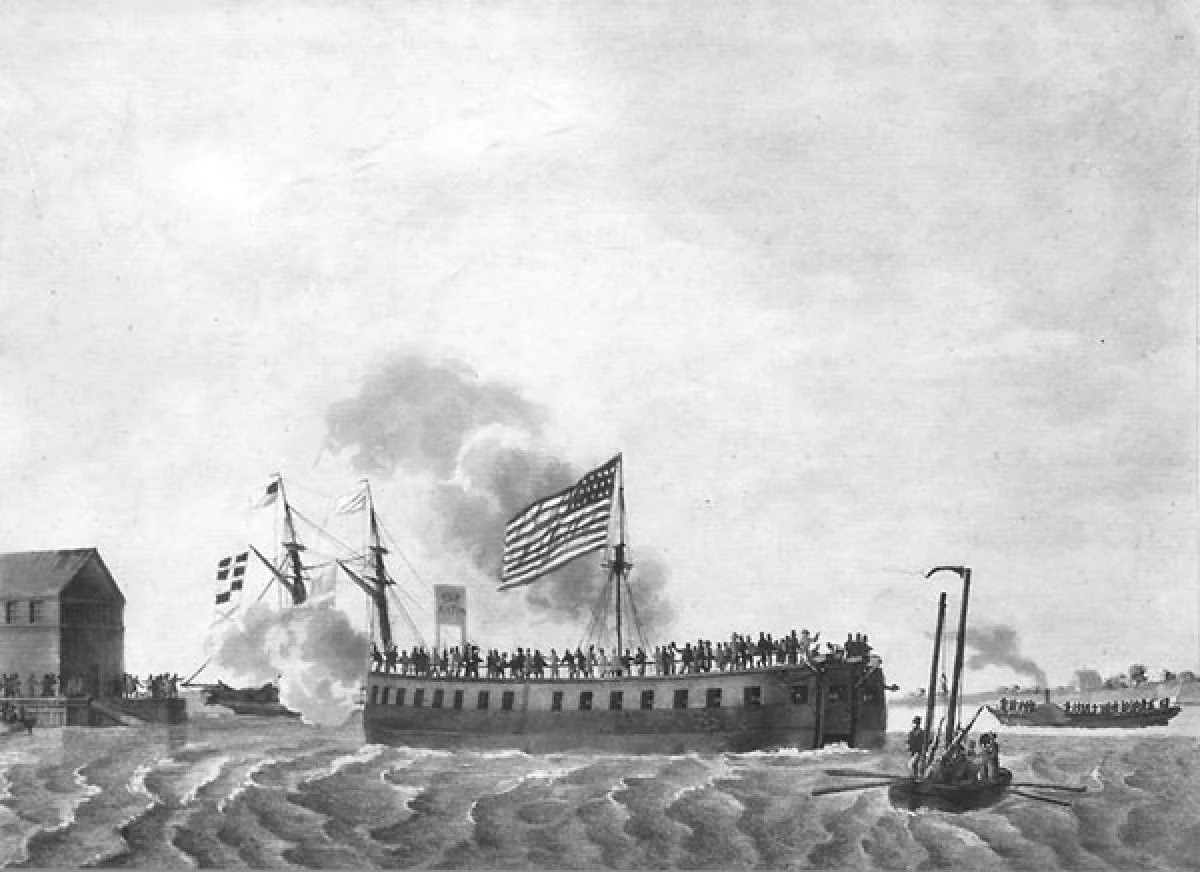
His last major project was the Demologos, a floating battery designed for the United States Navy during the War of 1812. It is considered the world’s first steam-powered warship. Construction began in 1814, during Fulton’s lifetime, but the vessel was not completed until after his death, in 1815. It was subsequently renamed Fulton in his honour and delivered to the United States Navy in 1816.
In 1814, Fulton was elected a member of the American Antiquarian Society, an American institution dedicated to the preservation and study of history.
Robert Fulton died of tuberculosis in New York in February 1815, at the age of 49. Historical sources differ regarding the exact date of his death: some indicate February 23, while others give February 24, 1815.
Robert Fulton: A Pioneer of the Maritime Industrial Revolution
The story of Robert Fulton demonstrates that great inventions are rarely the result of one person’s work alone. Before him, Claude de Jouffroy, John Fitch and William Symington had already conducted important experiments in steam navigation.
However, Fulton succeeded in transforming these technological advances into solutions capable of meeting genuine economic and commercial needs. With the Clermont, he helped establish the steamboat as a reliable and profitable means of transportation. His research into submarines, torpedoes and military vessels also demonstrates the breadth of his inventive abilities.
His legacy therefore goes far beyond the simple invention of the steamboat. It lies above all in his ability to transform an experimental technology into a practical application, opening a new era for inland waterway transportation, trade and the development of maritime exchanges.
Bibliography and Main Historical Sources
– OXFORD UNIVERSITY PRESS – AMERICAN NATIONAL BIOGRAPHY. “Robert Fulton”. Biographical entry covering Robert Fulton’s life and achievements. https://academic.oup.com/american-national-biography/reference/63042/reference-article-abstract/570377961
– SUTCLIFFE, Alice Crary. Robert Fulton and the “Clermont”: The Authoritative Story of Robert Fulton’s Early Experiments, Persistent Efforts, and Historic Achievements. New York: The Century Co., 1909. Historical work devoted to Robert Fulton’s experiments and achievements. https://www.gutenberg.org/files/57742/57742-h/57742-h.htm
– PHILIP, Cynthia Owen. Robert Fulton: A Biography. New York: Franklin Watts, 1985. Biographical work covering Robert Fulton’s life, inventions and achievements.
– DICKINSON, H. W. Robert Fulton, Engineer and Artist. A reference work on Fulton’s career, particularly his engineering work and experiments with the Nautilus submarine. https://www.museum.state.il.us/RiverWeb/landings/Ambot/Archives/dickinson/chapter6.html
– HISTORY OF MERCHANT SHIPPING AND ANCIENT COMMERCE. Historical work containing information on the technical characteristics of the Clermont steamboat. https://www.gutenberg.org/files/74393/74393-h/74393-h.htm
– HANOVER COLLEGE. “Location – New Orleans” and “1811 – Fall”. Historical documents relating to the voyage of the New Orleans steamboat, particularly its departure from Pittsburgh in October 1811 and its journey along the Mississippi River. https://history.hanover.edu/texts/1811/Web/Location-NewOrleans.html; https://history.hanover.edu/texts/1811/Web/1811-Fall.html
– NAVAL HISTORY AND HERITAGE COMMAND. “Fulton I (Catamaran Steam Frigate)”. Historical entry devoted to the Demologos, also known as the Fulton, and its history within the United States Navy. https://www.history.navy.mil/research/histories/ship-histories/danfs/f/fulton-i.html
– SCIENCE MUSEUM GROUP. “Fulton, Robert (1765–1815)”. Biographical entry presenting Robert Fulton’s career and work in engineering and navigation. https://collection.sciencemuseumgroup.org.uk/people/cp37293/fulton-robert
– SMITHSONIAN LIBRARIES. “Fulton, Robert”. Documentary reference providing access to documents and letters by Robert Fulton preserved by the Smithsonian Libraries. https://library.si.edu/digital-library/author/fulton-robert
– FULTON, Robert. “Account of the First Steam Trip to Albany” (1807). Robert Fulton’s historical account of his steamboat’s journey between New York, Clermont and Albany, covering a distance of 150 miles in 32 hours. https://www.historycentral.com/documents/Fultonship.html
– WIKIPEDIA. “Robert Fulton”. Encyclopaedia article presenting Robert Fulton’s biography, inventions and main achievements. https://fr.wikipedia.org/wiki/Robert_Fulton