
CALL FOR CONSULTANCY – STRENGTHENING AFRICAN SIDS READINESS TO INTEGRATE FISHERIES VALUE CHAINS INTO CONTINENTAL TRADE UNDER THE AFCFTA
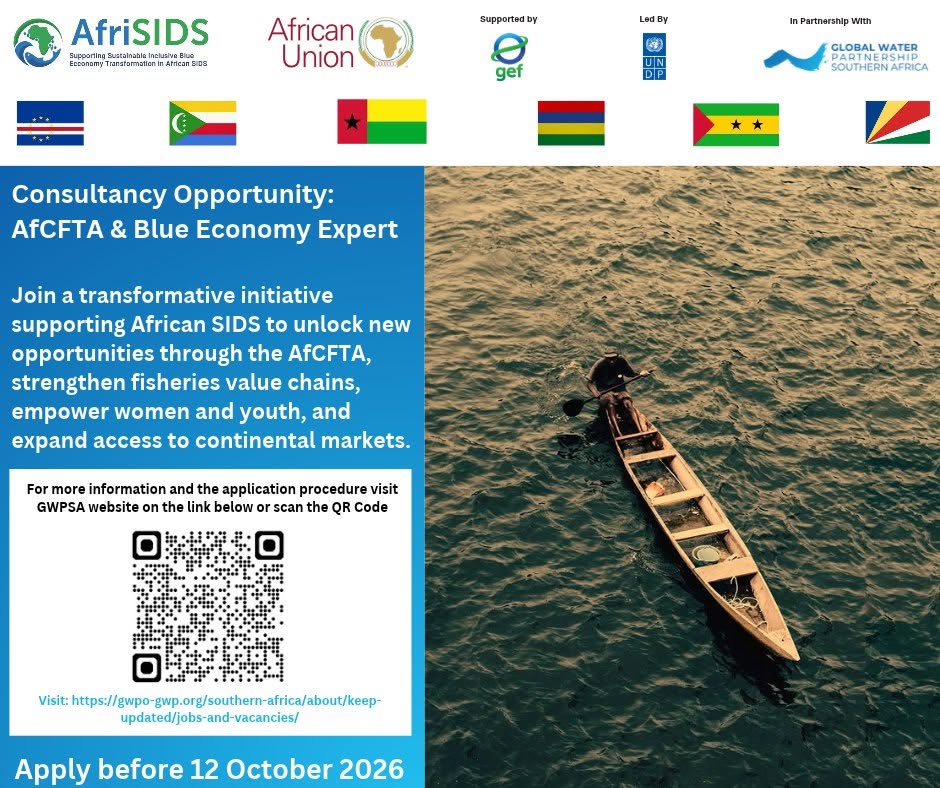
Deadline : 12 October 2026
1. Background and rationale
African Small Island Developing States face structural constraints to participating in regional and international trade: narrow production bases, geographic isolation, high exposure to climate change, and limited economies of scale. They are at the same time endowed with significant marine and coastal natural capital and a private sector that drives socio-economic growth, which gives the Blue Economy, and fisheries particularly, a strong foundation for inclusive, resilient and sustainable development.

The African Continental Free Trade Area (AfCFTA) Agreement has been negotiated, and its State Parties are now implementing it. For African SIDS, the task is therefore not to renegotiate the agreement but to assess their readiness, to analyse the gaps between what countries currently do and the requirements of the AfCFTA protocols, and to develop the regional fisheries value chains they can trade under the opportunities the agreement offers. Fishery products are frequently the leading export of African SIDS, yet they flow to markets outside the continent rather than within it, while Africa remains a net importer of fishery products sourced largely from outside Africa (FAO).
This assignment is undertaken under the UNDP-GEF project “Supporting Sustainable Inclusive Blue Economy Transformation in African SIDS”, which works with six African SIDS in the Atlantic and Indian Ocean: Cabo Verde, Comoros, Guinea-Bissau, Mauritius, São Tomé and Príncipe, and Seychelles. The Global Water Partnership Southern Africa is the Executing Agency, under the leadership of the African Union Commission and in collaboration with the AfCFTA Secretariat. It operationalises the project’s Component 1 work on aligning the Blue Economy of the SIDS with continental trade.
The AfCFTA Secretariat has already conducted country diagnostics for Cabo Verde, the Comoros and Zanzibar, with an emphasis on the economic empowerment of women in fisheries value chains under the AfCFTA. This assignment builds on those diagnostics and on the in-house country activities led by the Private Sector Unit, the Seychelles fisheries sector study and the Comoros national consultation, rather than repeating country fieldwork. It focuses on the trade-policy, legal-positioning, standards and advocacy dimension that positions African SIDS fisheries within the AfCFTA.